Sea-Ex Seafood
Trade Directory
Directory of Seafood
Companies by Species
Imported, Exported, Wholesale, Processors &
Producers
Click Here for
SEAFOOD DIRECTORY
Bluefin
Tuna (Thunnus maccoyii & Thunnus thynnus) Photographs
and Information
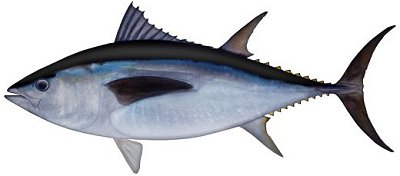
The southern bluefin
tuna, Thunnus maccoyii, is a tuna of the family
Scombridae found in open southern hemisphere waters of all the
world's oceans mainly between 30°S and 50°S, to nearly 60°S. At
up to 2.5 m (8.2 ft) and weighing up to 400 kg (882 lbs) it is
among the larger bony fishes.
The southern bluefin tuna is a large, streamlined, fast swimming
fish with a long, slender caudal peduncle and relatively short
dorsal, pectoral and anal fins. The body is completely covered
in small scales.
The body color is blue-black on the back and silver-white on the
flanks and belly, with bright yellow caudal keels in adult
specimens. The first dorsal fin colour is grey with a yellow
tinge, the second dorsal is red-brown, and the finlets are
yellow with a darker border.
Southern bluefin tuna, like other pelagic tuna species,
are part of a group of bony fishes that can maintain their body
core temperature up to 10 degrees above the ambient temperature.
This advantage enables them to maintain high metabolic output
for predation and migrating large distances. The southern
bluefin tuna is an opportunistic feeder, preying on a wide
variety of fish, crustaceans, cephalopods, salps, and other
marine animals.
Southern Bluefin Tuna
are an Endangered species
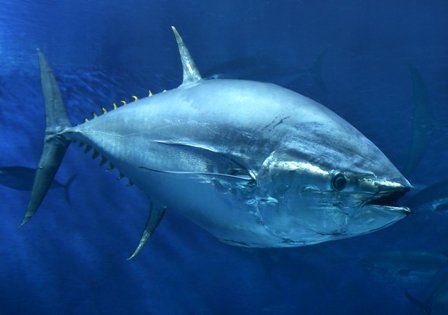
The Northern bluefin tuna (Thunnus
thynnus) is a species of tuna in the Scombridae family. It is variously known as
the Atlantic bluefin tuna, giant bluefin tuna (for individuals exceeding 150
kilograms or around 330 pounds) and formerly as the tunny. Atlantic bluefin are
native to both the western and eastern Atlantic Ocean, as well as the
Mediterranean Sea. Atlantic bluefin have become extinct in the Black Sea and
Caspian Sea. The Atlantic bluefin tuna is a close relative of the other two
bluefin tuna species—the Pacific bluefin tuna and the southern bluefin tuna.
Atlantic bluefin tuna are capable of reaching well over 450 kilograms
(992 lb) in weight, and rival the black marlin and blue marlin as the largest
Perciformes. Throughout recorded history, the Atlantic bluefin tuna has been
highly prized as a food fish. Bluefin have been a valuable commercial catch from
the time of the ancient Greeks and Phoenicians to the modern era. Besides their
commercial value as food, their great size and the speed and power they display
as apex predators has attracted the admiration and respect of both ancient and
modern fishermen, as well as writers, sport anglers and scientists.
Longtail tuna (Thunnus tonggol) are
similar in appearance to southern bluefin,
but can be distinguished by their shorter
pectoral fins and dark caudal keels.
Did you know?
Bluefin tunas have streamlined
bodies built for speed and endurance. They can even retract
their dorsal and pectoral fins into slots to reduce drag.
Did you know? In
January 2001, a prime, 444-lb (201-kg) bluefin tuna sold in a
Japanese fish market for $173,600 (¥20.2 million), a world
record.
Did you know?
Bluefin Tuna are warm-blooded, a rare trait among fish
Did
you know? Bluefin Tuna can reach speeds of
up to 70 km/hr and are known as "The Porsche of the Sea"
Did you know? Tuna cannot pump water over their gills like other fish,
instead they swim with their mouths open which forces the
water over their gills. If they stop swimming they will
suffocate.
Did you know? Tuna have hearts that are much larger than other fish,
they are about 10 times as large, relative to the size of
the body.
Nutritional
Information
For every 100 grams raw product
for Tuna fillet.
Kilojoules
521 (124
calories)
Cholesterol
30 mg
Sodium
37 g
Total fat
(oil)
0.5 g
Saturated
fat
33% of total
fat
Monounsaturated fat
13% of total
fat
Polyunsaturated fat
54% of total
fat
Omega-3, EPA
14 mg
Omega-3, DHA
100 mg
Omega-6, AA
15 mg
Angling for
Bluefin Tuna | Tuna
Fishing
:
It is a prized sporting fish which will take small lures and also live
bait.
They travel in schools of similar sized
fish. Their diet consists of a variety of crustaceans, cephalopods, and fish
including anchovies and pilchards.
The most popular method of catch this powerful, hard fighting fish is trolling.
It can also be taken from boats or from the shore using live scombroid fishes
(mackerels and little tunas) for bait. It is rarely taken on dead baits. Hooked
fish are prone to fast surface runs and deep sounding.
Current Southern Bluefin Tuna All
Tackle Record (IGFA) 369 lbs. 4 ounces.
Current Pacific Bluefin
Tuna All Tackle Record (IGFA) 716 lbs. 8 ounces.
Current Atlantic
Bluefin Tuna All Tackle Record (IGFA) 1496 lbs. 0 ounces.
About Southern Bluefin Tuna in
Australia:
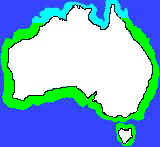
Distribution - Southern bluefin
tuna are highly migratory pelagic fish. In Australian waters they range from
northern NSW around southern Australia to north-western Australia. They tend to
form large surface schools in offshore waters off southern Australia at certain
times of the year. Overfishing has drastically reduced its numbers.
Size - Southern bluefin tuna can reach a maximum length of 2.35 metres
and can attain a weight of around 200kg, but rarely exceed 100kg in Australian
waters.
Characteristics - Southern bluefin tuna are a member of the family
Scombridae and are recognised by their relatively short pectoral fins and robust
body. Their upper bodies are blackish-blue and the underside is a silver colour.
Juvenile and adult southern bluefin are opportunistic feeders that feed mainly
on squid, crustaceans, fish and planktonic animals.
Confusing Species - Longtail tuna (Thunnus tonggol)
are similar in appearance to southern bluefin, but can be distinguished by their
shorter pectoral fins and dark caudal keels.
Video: 700lb Bluefin Tuna:
Video:
World Record of Giant Bluefin Tuna 1496 lbs Ken Fraser:
Cooking
Bluefin
Tuna:
All bluefin species
are highly prized for sushi and sashimi
Colour of Raw
fillet:
Pink to red.
Texture:
Medium to Firm.
Fat Content:
Low to high.
Flavour:
Rich, mild and meaty when
cooked.
Microwave Cooking
Times for Fish
- Fish fillets – 5 minutes per 500g on medium-high, +50
seconds more for thicker fillets, or until flesh flakes
- Whole fish - Large – 6 minutes/750g on medium
- Whole fish – Small – 3-4 minutes on medium
Bluefin are
captured for the commercial market by professional fishermen
using purse seine gear, assorted hook-and-line gear, most
importantly the longline, and in certain areas by harpooners.
Atlantic bluefin are also taken commercially by heavy rod and
reel gear.
The main
methods of fishing have varied over the years but have included pole and line
fishing (using live baits), sea-surface set baited long lines (often many
kilometres long) and purse seine enclosure nets.
Some 98 per cent of Australia's SBT catch
today is taken by purse seiners and transferred into sea cages anchored off Port
Lincoln, South Australia, where they are fattened for sale, primarily to Japan.
The Australian SBT fishery is managed by
the Australian Fisheries Management Authority (AFMA) on behalf of the Australian
Government. AFMA can determine a Total Allowable Catch (TAC) for the fishery of,
at most, the allocation to Australia determined by the Commission for the
Conservation of Southern Bluefin Tuna (the Commission).
Video: Australian Bluefin - Fishing with Vision.
Commercial poling for Bluefin Tuna
AUSTRALIA'S SOUTHERN BLUEFIN TUNA
stocks will be protected after federal Environment Minister Tony Burke listed
the species under national laws. The tuna would be listed as "conservation
dependent", he said on Wednesday.
Professor Craig Franklin from the University of Queensland welcomed the new
listing. "It's important and it's well overdue," he says. "The species has been
under pressure for a long time due to its value."
Ninety per cent of southern bluefin tuna (Thunnus maccoyii) are caught near
the Great Australian Bight, in South Australia, as juveniles. They are then
farmed until they reach maturity, and sold to a dozen international markets,
including Japan where the meat is prized for use as sashimi.
"While ongoing improvements in management measures are helping to stabilise the
population, the breeding population is still considered to be less than eight
per cent of unfished levels," the minister says.
One of these improvements was made by the Port Lincoln-based fishing company
Clean Seas, which in 2009 became the first company in the world to breed
southern bluefin tuna in captivity.
Fishing still allowed
However, the listing would not restrict fishing or burden the fishing industry
with regulation, the minister added. "Fishing can continue under existing
arrangements, but it will now be a legal requirement that the species remain
under a plan of management that includes actions to stop its decline and support
its long-term recovery," he says.
Tony stressed that only global management could help the migratory species
recover.
Australia is one of the countries in the Commission for the Conservation of
Southern Bluefin Tuna, which sets global southern bluefin tuna catch quota
levels. The commission aims to reduce the global southern bluefin tuna catch by
20 per cent over the 2010 and 2011 seasons.
In October 2009, the Australian quota for catching bluefin tuna was cut from
5,265 t to 4,015 t. However, that's not low enough for environmental group
Greenpeace, which argues the species is on the brink of collapse and has been
lobbying for a zero catch to be imposed until 2030.
WILD
CAUGHT SOUTHERN BLUEFIN TUNA: Predominantly purse seine caught with minor
longline catches; overfished with a severely depleted population; assessed as
‘critically endangered’ by the IUCN and threatened in NSW and VIC; Australian
fishery mostly targets juveniles for fattening up in sea cage aquaculture
operations; long-lived, late-maturing species that is vulnerable to fishing
pressure; potential negative ecosystem effects of severe depletion of this high
level predator species.
FARMED
SOUTHERN BLUEFIN TUNA: Farmed in sea cages after wild capture; mostly caught
as juveniles in the wild before being transferred to sea cages for fattening up;
very poor feed conversion ratio, meaning less fish is produced than is fed to
the Tuna; feed sourced from fisheries with dolphin bycatch issues.
More links about
Bluefin Tuna and Tuna Information
The Tuna Research
and Conservation Center is a collaboration between Stanford
University's Hopkins Marine Station and The Monterey Bay Aquarium. The
mission of the Tuna Research and Conservation Center (TRCC) is to
advance the knowledge and understanding of tunas and other highly
migratory marine fishes through research, education, and conservation.
Great Site for Information on Tuna
Tagging and Research.
Bluefin tuna are monumental in
size, speed, power, value, and charisma. They are among the largest fish
on earth and make trans-oceanic migrations at speeds to rival the
fastest racehorses. They dive to abyssal depths of nearly a mile and ply
waters from the equator to frigid polar seas. Amazingly, they have the
capacity to maintain a warm, stable body temperature throughout their
wide thermal niche like a mammal or bird. They have captivated humans
for millennia; images of bluefin once graced the same coins as Hercules
The Commission for the Conservation of Southern Bluefin Tuna
(CCSBT) is an intergovernmental organisation responsible for the management of
southern bluefin tuna throughout its distribution. The CCSBT's objective is to
ensure, through appropriate management, the conservation and optimum utilisation
of southern bluefin tuna. Members of the Extended Commission comprise:
Australia, the Fishing Entity of Taiwan, Indonesia, Japan, Republic of Korea and
New Zealand. Cooperating Non-Members comprise: the Philippines, South Africa and
the European Union
The Australian Marine Conservation Society - Fact sheets about Southern
Bluefin Tuna. How old do bluefin tuna get? How long can they grow?
How heavy are bluefin tuna? When do they breed?
West
Coast Tuna Fishing History - The Rise & Fall of the Tuna Industry in San Diego
USA. Written by Arnold Fernandes - The Tuna Industry in San Diego was
started by the Chinese and Japanese in the early 1890s and then was dominated by
the Portuguese and Italians in the early 1920's and up until the late 1980's.
Many of the San Diego Fishermen started out on the East Coast and ended up in
San Diego, California to escape the ruthless storms and bitter cold of the North
Atlantic Ocean. My father came to the East Coast from Portugal and started out
as a doryman on the Gloucester Schooners fishing off of the Grand Banks in the
North Atlantic.......
San Diego Tuna Boats -
Hi, my name is Jimmy, I’m second generation Portuguese on my Dad’s side and
first generation on my Mom’s. I've always had a passion for Tuna Boats and their
colorful history and have, over the years, amassed a large library of photos and
many stories to go with them. In the hopes of keeping some of this history
alive........
Tuna Association of
Ecuador - Tuna Association of Ecuador, Atunec, is headquartered in the city
of Manta, Ecuador, Manabi province, which accounts for the main fleet of vessels
fishing for tuna in the Eastern Pacific Ocean. Tuna vessel owners union members
to generate strategies working in partnership and defense of their interests,
seek common solutions to optimize the operations of the national fishing fleet
and, in particular the associated
Commonwealth Fisheries Association - The Commonwealth Fisheries Association
is committed to ensuring the commercial fishing industry is recognised for its
contribution to Australia’s economy, society and environment. CFA achieves this
by promoting and advocating the value of the industry and the healthy seafood it
provides to the community. Commonwealth wild harvest fisheries are among the
best managed and environmentally sustainable fisheries in the world. Our members
are committed to managing fisheries for Australia’s food security, community
well-being and healthy marine eco-systems.