|
|
|
|
|
Directory & Info for
Fishing,
Angling, Fishing Tackle, Fishing Guides, Fly Fishing, Bass Fishing,
Sports fishing, Game Fishing....
Info on All types of
Fishing | Angling | Fishing Tackle etc. |
| |
|
Glossary of Fish, Seafood and Fishing Terms |
|
|
|
Australian Fish Bag Limits and Size Regulations |
|
Photos of Australian Seafood, Fish, Crustaceans &
Cephalopods and Information on each... |
|
Abalone, Blacklip |
|
Albacore
Tuna |
|
Baler Shell |
|
Barbounia, Tiny |
|
Barracouta |
|
Barramundi |
|
Bass, Sea |
|
Batfish |
|
Batfish, Silver |
|
Blackfish |
|
Boarfish |
|
Bonito Tuna |
|
Bonito, Watson's Leaping |
|
Bream |
|
Bream, Butter |
|
Bream, Slate |
|
Bug, Moreton Bay
(Slipper Lobster) |
|
Bug, Balmain |
|
Butterfish |
|
Calamari,
Southern |
|
Carp, European |
|
Catfish, Blue |
|
Catfish, Lesser Salmon |
|
Cockles |
|
Cod, Bar |
|
Cod, Blue eye |
|
Cod, Coral Rock |
|
Cod, Ghost |
|
Cod, Maori |
|
Cod, Murray
|
|
Cod, Southern Rock |
|
Cod, Spotted |
|
Cod, Tomato |
|
Cod, Wirrah |
|
Cod, Yellow Spotted |
|
Coral Trout |
|
Cowanyoung |
|
Crab, Blue Swimmer |
|
Crab, Champagne |
|
Crab, Giant
|
|
Crab, Mud |
|
Crab, Spanner |
|
Crawfish |
|
Cuttlefish |
|
Dart Fish |
|
Dolphin Fish |
|
Dory, John |
|
Dory, Mirror |
|
Dory, Silver
|
|
Drummer, Southern |
|
Eel, Longfin |
|
Emperor, Red |
|
Emperor, Red Throat |
|
Flathead |
|
Flounder, Small Toothed |
|
Flutemouth, Rough |
|
Frost Fish |
|
Garfish |
|
Gemfish |
|
Goatfish |
|
Grouper |
|
Gurnard, Red |
|
Gurnard, Spotted |
|
Hairtail |
|
Hump Headed
Maori Wrasse |
|
Hussar |
|
Jackass Fish |
|
Jacket, Ocean |
|
Jacket, Sea |
|
Jewfish |
|
Jobfish, Gold Banned |
|
Jobfish, Rosy |
|
Kingfish,
Yellowtail |
|
Latchet Fish |
|
Leatherjacket, Reef |
|
Ling |
|
Lobster Eastern
Rock |
|
Lobster Southern Rock |
|
Long Tom |
|
Luderick |
|
Mackeral, Jack |
|
Mackerel, Slimey |
|
Mado |
|
Mahi Mahi |
|
Mangrove Jack |
|
Marlin, Black |
|
Marlin, Blue |
|
Marlin, Striped |
|
Melon Shell |
|
Monkfish |
|
Mono |
|
Moon Fish |
|
Morwong |
|
Morwong, Red |
|
Mullet - Roe |
|
Mullet, Diamond Scale |
|
Mullet, Red |
|
Mullet, Sea |
|
Mullet, Yelloweye |
|
Mulloway |
|
Mussels Black |
|
Mussels Greenlip |
|
Nanygai |
|
Octopus |
|
Orange Roughy |
|
Oreo, Black |
|
Oyster,
Native |
|
Oyster,
Pacific |
|
Oyster, Sydney Rock |
|
Parrot Fish |
|
Parrot Fish (2) |
|
Perch, Ocean |
|
Perch, Saddle Tail Sea |
|
Perch, Silver |
|
Perch, Splendid |
|
Perch, Stripey Sea |
|
Pig Fish |
|
Pike |
|
Pineapple Fish |
|
Prawn, Banana |
|
Prawn, King |
|
Prawn, Red Spot |
|
Prawn, School |
|
Prawn, Tiger |
|
Queenfish, Needleskin |
|
Rainbow Runner |
|
Redclaw Crayfish |
|
Redfish |
|
Ribaldo |
|
Ribbon Fish |
|
Rudder Fish |
|
Salmon, Atlantic |
|
Salmon, Australian |
|
Scad |
|
Scallops,
Queensland |
|
Scallops, Tasmanian |
|
Scorpion Fish, Raggy |
|
Shark |
|
Shark Black Tip |
|
Shark, Blue |
|
Shark Bronze Whaler (Dusky) |
|
Shark, Bull |
|
Sharks Fins |
|
Shark, Gummy |
|
Shark, Mako |
|
Shark, School |
|
Shark,
Tiger |
|
Shark,
Whiskery Reef |
|
Shark, White |
|
Shrimp, Mantis |
|
Sicklefish |
|
Silver Biddy |
|
Snapper |
|
Snapper, Big Eye |
|
Snapper, Fry Pan |
|
Snapper, Gold Band |
|
Snapper, King |
|
Snapper,
Red |
|
Snapper, Red Tropical |
|
Sole |
|
Sole, Tongue |
|
Squid, Arrow |
|
Squirrel Fish |
|
Stargazer |
|
Stingray, Butterfly |
|
Stripey Sea
Perch |
|
Surgeonfish, Sixplate Sawtail |
|
Sweetlip, Slatey |
|
Sweetlip, Yellow |
|
Swordfish |
|
Tailor |
|
Tarwhine |
|
Tilefish,
Pink |
|
Trevally, Big Eye |
|
Trevally, Golden |
|
Trevally, Silver |
|
Triple Tail |
|
Trout |
|
Trumpeter, Striped |
|
Tuna,
Albacore |
|
Tuna, Bigeye |
|
Tuna, Bluefin |
|
Tuna, Longtail |
|
Tuna, Skipjack |
|
Tuna, Striped |
|
Tuna, Mackerel |
|
Tuna, Yellowfin |
|
Venus Tusk Fish |
|
Whiting, Sand |
|
Whiting, School |
|
Wrasse |
|
Yabby,
Freshwater Crayfish |
|
Yellowtail |
|
FULL LIST of Fish &
Seafood |
|
Beche De Mer
(Sea Cucumber - Trepang) |
|
Amberfish |
|
Blackfish |
|
Black Teatfish |
|
Brown Sandfish |
|
Curryfish |
|
Elephants Trunks fish |
|
Greenfish |
|
Lollyfish |
|
Pinkfish |
|
Prickly Redfish |
|
Sandfish |
|
Stonefish |
|
Surf Redfish |
|
White Teatfish |
|
|
|
Commercial
Seafood Directory |
|
Sea-Ex Seafood, Fishing, Marine
Directory |
|
Aquaculture Directory |
|
Commercial Fishing |
|
Seafood Information by
Country |
|
Australian Fish Photos &
Info |
|
Interesting Fish Facts & Trivia |
|
Country Directories |
|
Thailand Business
Directory |
|
Seafood: |
|
Wholesale Seafood
Suppliers Australia |
|
Wholesale Seafood
Suppliers International |
|
Retail Seafood Sales |
|
Seafood Restaurants |
|
Seafood Recipes |
|
Seafood Information |
|
Seafood
Industry Resources |
|
Yellowtail Kingfish (Seriola lalandi) Photographs
and Information
|
This species is most commonly called
kingfish, yellowtail kingfish, yellow-tailed kingfish, yellowtail, king, kingy
or "kingi". Colloquial titles include "hoodlum" and "bandit", while smaller
specimens are often nicknamed "rats" or nor' headers. Some confusion exists
between the kingfish and two of its near relatives; the amberjack and the Samson
fish, while an unrelated species, the cobia (Rachycentron canadus) is also
commonly called black kingfish.
It is also known as
yellowtail (Qld, SA, Tas.), kingie, Tasmanian yellowtail (Tas.);
kingfish, southern yellowtail
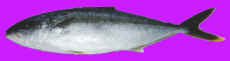
Yellowtail Kingfish have elongated, moderately compressed bodies. They have a
slender head longer than their body depth and they have 31-34 dorsal fin rays. They
are generally blue, blueish-green or purplish green above and silver-white below.
Yellowtail Kingfish can be distinguished by their yellow caudal fins.
Habitat: A pelagic species that hang out in small schools near
the coast and offshore islands and reefs. Most common around the
North Island. Available year round but more so during the summer
months.
|
 |
 |
|
|
| Scientific Name |
Seriola lalandi |
| Location |
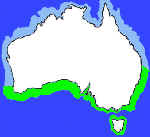
Sth QLD to TAS, SA, VIC, sth WA |
| Season |
January to May |
| Size |
2.4 metres, 65 kg |
| Australian Species Code |
37 337006 |
| Taste, Texture |
Mild to strong flavour, firm texture. |
|
Nutritional
Information
For every 100 grams raw product
for Yellowtail Kingfish fillet. |
|
Kilojoules |
428 (102
calories) |
|
Protein: |
21.6 g |
|
Cholesterol |
24 mg |
|
Sodium |
- |
|
Total fat
(oil) |
1.1 g |
|
Saturated
fat |
36% of total
fat |
|
Monounsaturated fat |
24% of total
fat |
|
Polyunsaturated fat |
39% of total
fat |
|
Omega-3, EPA |
44 mg |
|
Omega-3, DHA |
238 mg |
|
Omega-6, AA |
30 mg |
|
|
Yellowtail Kingfish have elongated, moderately compressed bodies. They have a
slender head longer than their body depth and they have 31-34 dorsal fin rays. They
are generally blue, blueish-green or purplish green above and silver-white below.
Yellowtail Kingfish can be distinguished by their yellow caudal fins.
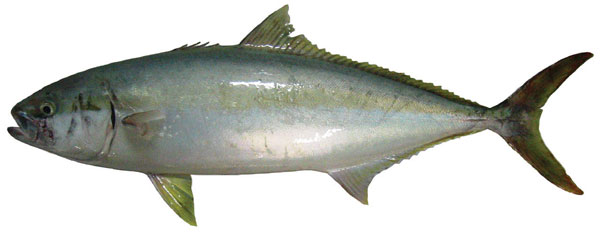
The yellowtail kingfish is
a powerful, pelagic fish characterised by its bright-yellow
tail. Colouration varies slightly between individuals, but is
usually dark green or blue on the back, shading through metallic
blue-green to silver and white or off-white on the belly. A
distinct gold or yellowish stripe runs along each flank of a
freshly caught kingfish.
 Large schools of "rat"
kingfish in the 1 to 4 kg range are often encountered, and
school fish of 6 to 12 kg fish are relatively common in some
areas, too. Bigger fish in the 15 to 30 kg range tend to form
much smaller schools. The maximum growth potential of this
species is in the excess of 60 kg. Large schools of "rat"
kingfish in the 1 to 4 kg range are often encountered, and
school fish of 6 to 12 kg fish are relatively common in some
areas, too. Bigger fish in the 15 to 30 kg range tend to form
much smaller schools. The maximum growth potential of this
species is in the excess of 60 kg.
Kingfish are found
in the cool, temperate and sub-tropical waters of Australia, New
Zealand and nearby islands; including Lord Howe and Norfolk. A
similar or identical fish is found off the south-western coast
of North America. Kingfish mainly frequent the waters around
offshore reefs, pinnacles and islands, as well as inshore reef
systems, large bays and even deep estuaries. They prefer fairly
clean water with a temperature of 18 degrees Celsius or more,
but will occasionally stray into cooler areas.
Yellowtail Kingfish are distributed globally in the cool temperate waters of the
Pacific and Indian oceans off South Africa, Japan, southern Australia and the United
States of America.
In Australian waters, Yellowtail Kingfish are distributed from North Reef in Queensland
around the southern coast to Trigg Island in Western Australia. They also occur off
the east coast of Tasmania, around Lord How and Norfolk Islands.
They live in inshore and continental shelf waters where they are associated with reefs,
jetties and pylons. Adult yellowtail kingfish are solitary or occur in small groups
and can be found near rocky shores, reefs and islands. Schools of juveniles are
generally found in offshore waters often near or beyond the continental shelf. They
prefer waters with temperatures between 18°C and 24°C, although they are occasionally
found in cooler water.
Fishing for
Yellowtail Kingfish:
The yellowtail kingfish is a strong, exciting gamefish that
strikes savagely at a wide range of lures, live baits and dead
or cut flesh offerings. One of the most successful way to take
them is to present a live bait such as a slimy mackerel or
yellowtail scad at the depth at which the kingfish are
schooling. This may involve the use of a running or fixed sinker
on the line. Slow trolled live baits, large, deep diving minnow
lures and metal jigs worked vertically over the seabed are also
readily taken by these fish at times.
|
|
Cooking
Yellowtail Kingfish:
Yellowtail kingfish have a medium to
strong, distinct and pleasing flavour. They have few bones
and are often sold as cutlets or steaks, but they can be
cooked whole. Yellowtail kingfish are excellent when grilled
or broiled and barbequed. Kingfish are great for Sushi and Sashimi.
|
|
Commercial Fishing for
Yellowtail Kingfish:
The major commercial fishery for yellowtail kingfish is in New South Wales. In
Queensland, yellowtail kingfish are taken as an incidental catch in the snapper handline
fishery. They are caught by using surface or subsurface traps, trolling, bottom set longlines, poling and bottom set traps, handlines, droplines, longlines and bottom set
gillnets. They are usually marketed as whole, gilled and gutted fish. They are
sold on the domestic market in cutlet or fillet form, with better quality fish being sold
for sashimi.
|
|
Yellowtail Kingfish Links & Resources
|
|