Sea-Ex Seafood
Trade Directory
Directory of Seafood
Companies by Species
Imported, Exported, Wholesale, Processors &
Producers Click Here for
SEAFOOD DIRECTORY
Spanner Crab (Ranina
Ranina) Photographs
and Information
Also known as Frog Crab and Red Frog Crab
and Curacha Crab, Kona Crab (USA)
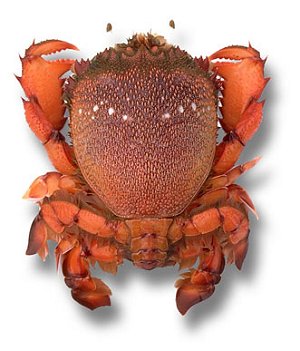
Spanner Crabs have elongated shells, which is very broad at the front. The first
legs are "spanner" shaped and the rest are flattened and have numerous short
bristles.
The spanner crab's body colour varies from orange to red.
Spanner Crabs prefer bare sandy areas. They inhabit intertidal waters to depths
of more than 100m, from sheltered bays to surf areas.
Spanner crabs remain completely buried in the sand for most of the day, but they emerge
rapidly when food appears. Spanner crabs are opportunistic feeders, ie., they eat
what ever is available. Adults eat heart sea-urchins and a variety of small bivalve
molluscs, crustaceans, polychaete worms and fish. Spanner crabs are often found in
areas where there is an intensive night time prawn fishery, suggesting that discards from
the trawl catch may form a significant part of their diet.
There is evidence that sharks and turtles feed on spanner crabs and turtles take
advantage of crabs being caught in nets.
Spanner Crabs are
available wild-caught, these marine dwellers are found from
close inshore to at least 100m, usually buried in sand from
where they attack small bottom-dwelling fish. Their long, almost
goblet-shaped, bright orange shells (even when uncooked) and
spanner-shaped front claws are quite distinctive. Found around
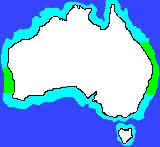
most of the Australian coast from NSW north to southern WA, they
are caught commercially, mainly using dillies, but also as a
bycatch of Prawn trawling, off southern Queensland and northern
NSW. The fishery has increased greatly since the early 1980s.
How a Crab Sheds its
shell or "Moults":
A crab’s growth isn’t continuous, but results from a series of
moults that happen when it reaches the size of its current
shell. Moulting is triggered by hormones. A new ‘cuticle’ (hard
protective layer) is secreted under the old shell. The crab
rapidly absorbs water, splitting its shell along suture lines,
then backs out of the old shell. Substances stored within the
crab’s body are rapidly redeposited to harden the new cuticle
into a larger shell. The fluid in the body is replaced with meat
during a period when the crab feeds voraciously.
Don't take home a crab
that has recently moulted their shell if you want a lot of meat!
For a Meaty crab choose one that has a shell with maybe some
scaring or algae growth, blunt teeth on their claws and if you
gently press the shell, there should be no movement.
Did you know? Spanner Crabs move in a forwards-backwards motion, unlike other crabs who move sideways.
Did you know? This
large crab is red in colour and stays the same colour when
cooked.
Scientific Name
Ranina Ranina
Location
East & West Coasts of Australia
Season
All year round
Size
To 150mm carapace length & 900 grams
Australian Species Code
28 865001
Taste, Texture
-
Nutritional Information
For every 100 grams raw product
for Crab meat.
Video Showing A Spanner Crab - how it moves
and burrows:
Video from Queensland Seafood about Spanner
Crab Fishing:
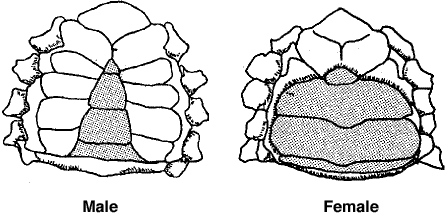
Male and female
crab identification
Fishing for Spanner Crabs:
Spanner crabs remain completely buried in the sand for most of the day, but they emerge
rapidly when food appears. Spanner crabs are opportunistic feeders, ie., they eat
what ever is available. Adults eat heart sea-urchins and a variety of small bivalve
molluscs, crustaceans, polychaete worms and fish. Spanner crabs are often found in
areas where there is an intensive night time prawn fishery, suggesting that discards from
the trawl catch may form a significant part of their diet.
Spanner crab meat is coarser in
texture than other species and known for its sweet flavour. They average about 400g and are usually sold cooked,
although they can occasionally be found live. Although they only
yield 25% meat, they are lower priced than other Crabs and some
chefs prefer their distinctive flavour.
This low- to medium-priced crab
species offers many cooking alternatives and adds a delicate
crab flavour to a variety of dishes. When this crab is
cooked whole, its bright orange shell is very attractive
served on a buffet or platter. For Asian-style cooking, spanner crabs make excellent clear consommes or Thai-style broths, and are a good choice as an
ingredient for won tons and dumplings.
Spanner Crabs are
caught commercially, mainly using dillies, but also as a bycatch of Prawn
trawling, off southern Queensland and northern NSW. The fishery has increased
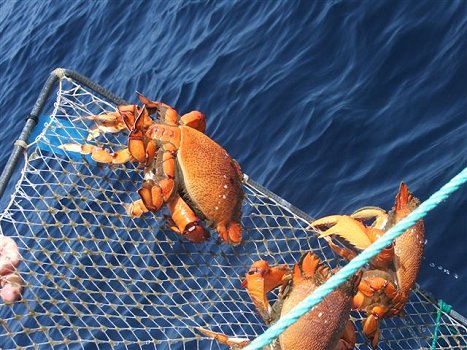
greatly since the early 1980s. Commercial spanner crab fishers are required by law to use
dillies - frames with netting stretched across them - no more than 1 metre
square in size.
A bait bag containing three or four bait fish is attached to each dilly. Ten or
15 dillies are clipped to a trotline by a short rope at about 50-metre
intervals. Each trotline is marked by a flagged buoy.
Spanner crabs are harvested all year round, except during a one-month spawning
season from 20 November to 20 December. Most of the Queensland catch is taken in
deep oceanic waters south of Yeppoon. Exporters, Importers, Processors
and suppliers of Spanner Crab are listed.